

A practical framework for diagnosing whether your organization needs a PMO, which type fits, and how to start without creating bureaucracy.
Someone eventually says it.
Projects are late. Status reports do not match reality. Priorities change every week. Teams are overloaded, but leadership still cannot see where the real constraints are.
Then the sentence lands in the room:
"We need a PMO."
Maybe you do.
But that sentence often hides several different problems. It can mean "we cannot see the work." It can mean "we cannot agree what matters." It can mean "teams keep waiting on each other." It can mean "decisions are too slow."
Those are different pains. They should not all get the same PMO.
A useful PMO is not a department you create because execution feels messy. It is an operating mechanism you design to remove a specific kind of friction.
So do not start with: "What should our PMO look like?"
Start with: "What pain are we actually trying to remove?"
The bad version asks for updates, creates templates, runs meetings, and produces dashboards that look clean but do not change the work.
Leaders get more reporting. Teams get more admin. Delivery does not improve.
That version deserves its reputation.
The useful version is different. A good PMO makes execution easier. It gives leadership a shared view of the portfolio, helps teams see dependencies earlier, creates a practical rhythm for decisions, and clarifies ownership without turning every project into a compliance exercise.
The difference is not the name. It is the mandate.
If your PMO only asks for updates, you built a reporting office, not an execution mechanism.
Before choosing a PMO model, diagnose the operating problem. Most organizations are dealing with one or more of five pains.

Leadership cannot see what is actually happening.
The portfolio exists, but only in fragments. One project is green because the team reports effort instead of outcomes. Another is blocked by a dependency nobody has escalated. A third is still active even though its business case quietly died months ago.
If leaders keep asking "what is actually going on?", the first PMO job is clarity.
Everything is important, which means nothing is.
Teams are asked to deliver strategic initiatives, operational improvements, customer commitments, internal fixes, and quick side projects at the same time. Nobody wants to say no, so the organization says yes to everything and pays for it through slow delivery.
If teams keep asking "what matters most?", the PMO needs to support trade-offs and capacity visibility.
Teams depend on each other, but the handoffs are unclear.
Sales needs Delivery. Delivery needs Product. Product needs Legal. Legal needs input from someone who is unavailable for two weeks. Every team may be doing its part, but the system stalls between teams.
If work keeps getting stuck between functions, the PMO should focus on dependencies, sequencing, and escalation.
Plans exist, but follow-through is inconsistent.
The kick-off is good. The slide deck is convincing. Then the rhythm fades. Owners become vague. Risks are mentioned but not managed. Milestones drift.
If the organization starts well but does not finish well, the PMO should improve planning quality, ownership, cadence, and follow-through.
Decisions are slow, inconsistent, or made in the wrong place.
Some decisions are escalated too high. Others are made too low without enough context. Approvals happen in side conversations. Risk tolerance is unclear.
If people keep asking "who is allowed to decide this?", the PMO can clarify decision rights, escalation routes, and standards.
There are many textbook PMO categories. Most leaders do not need them at the start.
In practice, four shapes cover most needs:
A Visibility PMO creates one shared view of the portfolio. It helps leaders see work, risk, milestones, dependencies, and capacity pressure.
Watch out: it can become a dashboard factory. The dashboard is not the product. Better decisions are the product.
A Coordination PMO helps work move across teams. It maps dependencies, sequences work, runs risk reviews, and escalates blockers before they become surprises.
Watch out: it needs enough mandate to challenge teams. Otherwise it becomes meeting coordination with nicer formatting.
A Governance PMO clarifies decisions, risks, approvals, and standards. Done well, it creates a cleaner operating model.
Watch out: governance should remove ambiguity. It should not turn normal execution into paperwork.
A Delivery Enablement PMO improves how teams plan, execute, and follow through. It coaches project leads, improves delivery rhythm, and raises the standard of execution.
Watch out: it must not take accountability away from teams. The PMO supports delivery; it does not become the place where ownership disappears.
Imagine a 300-person technology company with three strategic initiatives running at once:
Each initiative looks manageable alone. The problem is the overlap. The same product managers are needed in all three. Legal review is late on the pricing work. The data-platform upgrade changes assumptions for the portal. Sales has already promised launch dates Delivery has not committed to.
On paper, the company has a project problem.
In reality, it has a coordination and prioritization problem.
A heavy governance PMO would make this worse if it arrived with templates, approval gates, and weekly reporting demands. The first useful move would be smaller: one shared portfolio view, one dependency review, and one leadership trade-off forum where capacity conflicts become visible before they become delivery failures.
That is the point. The right PMO model depends on the friction.
You do not need a large PMO to start. You need a clear mandate and a few useful mechanisms.
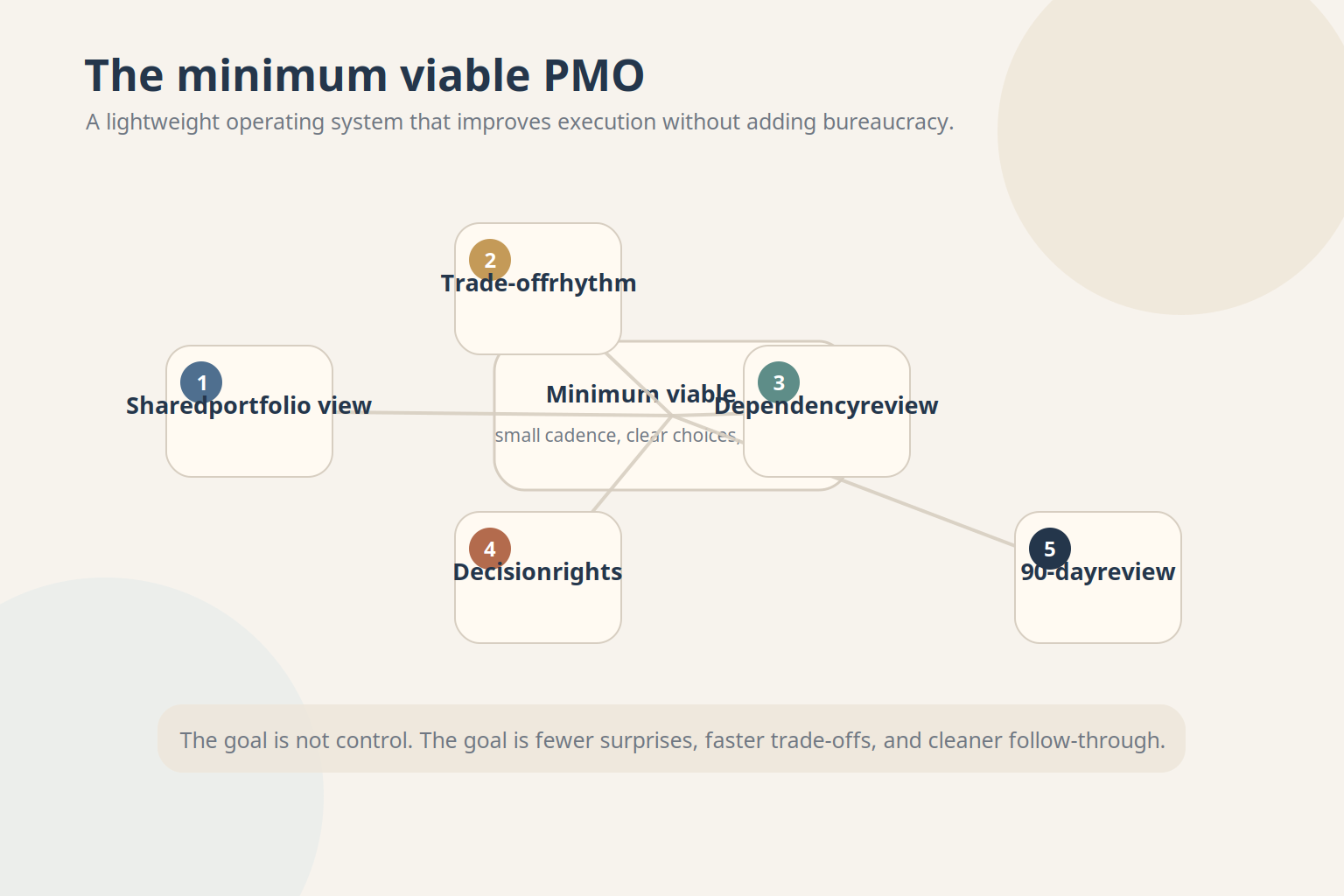
A minimum viable PMO can be as simple as:
That last point matters.
Do not measure the PMO by how many reports it creates, how many meetings it runs, or how many templates people use. Measure whether the original pain has gone down.
Can leaders see the work earlier? Are teams less overloaded? Are dependencies surfaced sooner? Are decisions faster? Are risks acted on? Are plans more realistic? Is delivery easier?
If yes, the PMO is earning its place.
If no, simplify it.
Use this as the first conversation:
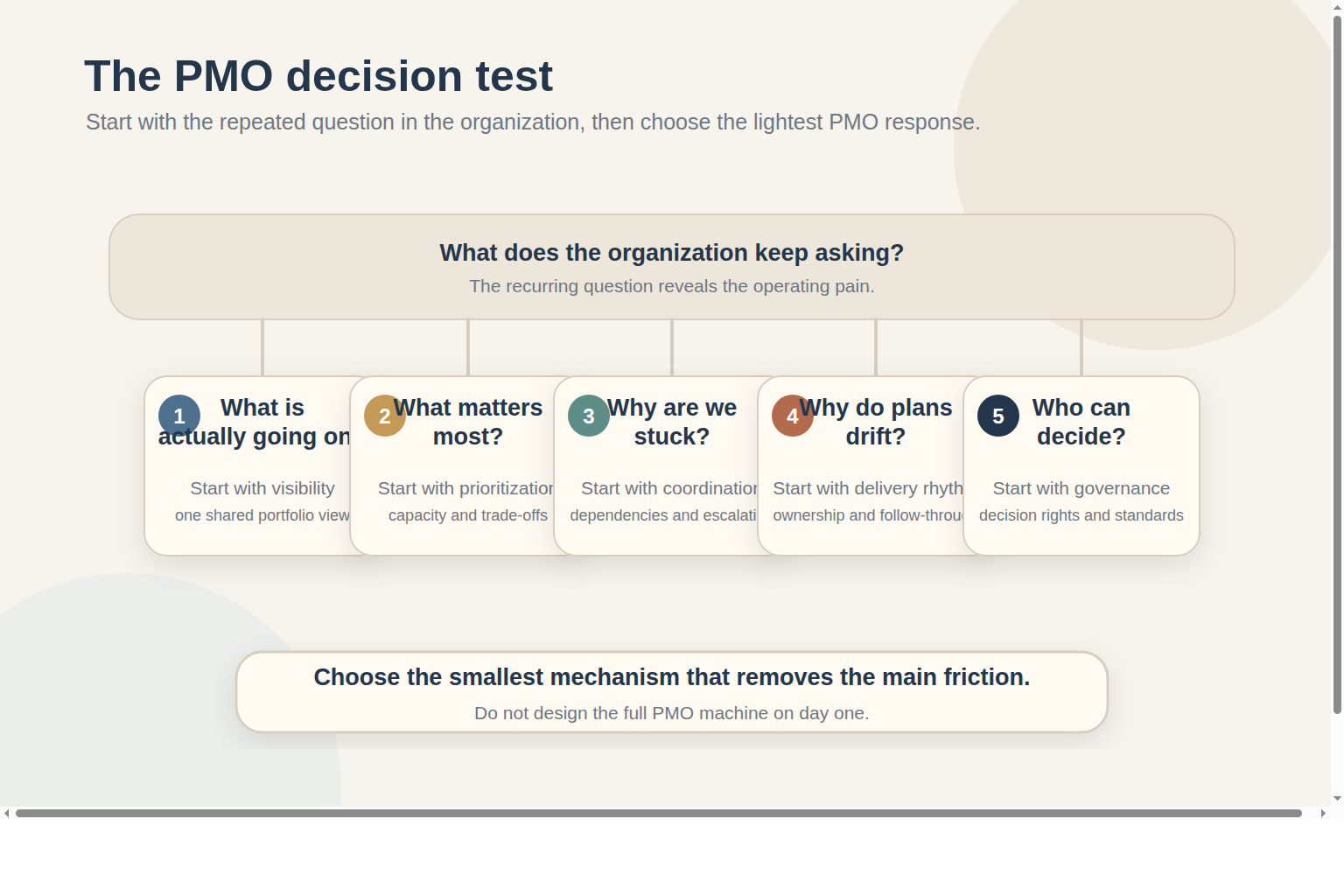
You may eventually need more than one shape. That is fine. But do not design the full machine on day one.
Choose the lightest structure that removes the main friction.
A weekly portfolio review may solve more than a new department. A shared dependency map may solve more than a methodology rollout. Clear decision rights may solve more than another steering committee.
The right PMO is not the biggest PMO.
It is the one that fits the pain.
Start with the pain, not the org chart.
Stay up to date with our informative blog posts.
Struggling with complex projects, IT leadership challenges, or strategic execution? With over 30 years of experience in delivering high-impact results—whether rescuing delayed initiatives, optimizing resources, or driving transformation—I provide the clarity, structure, and leadership needed for success.
Let’s discuss how I can help you achieve your goals. Schedule a call today!


